Ukulele Buddha Everywhere
Ukulele Buddha isn't only an iPhone app — it runs on iPad and Mac, and ships as a standalone Apple Watch app for the times a phone is one thing too many to hold.
Everything else in this guide describes the iPhone app, but the iPhone isn't the only place Ukulele Buddha lives. iPad and Mac get native versions with the same tools, laid out for a bigger screen. Apple Watch gets its own stripped-down app built for glancing at your wrist mid-song. None of this is a preview or a "coming soon" — all three ship today.
iPad
Ukulele Buddha is a universal app — there's no separate iPad target, just the same app recognizing it has more room to work with. Same four tabs, same Practice Hub, same catalog. What changes is the layout.
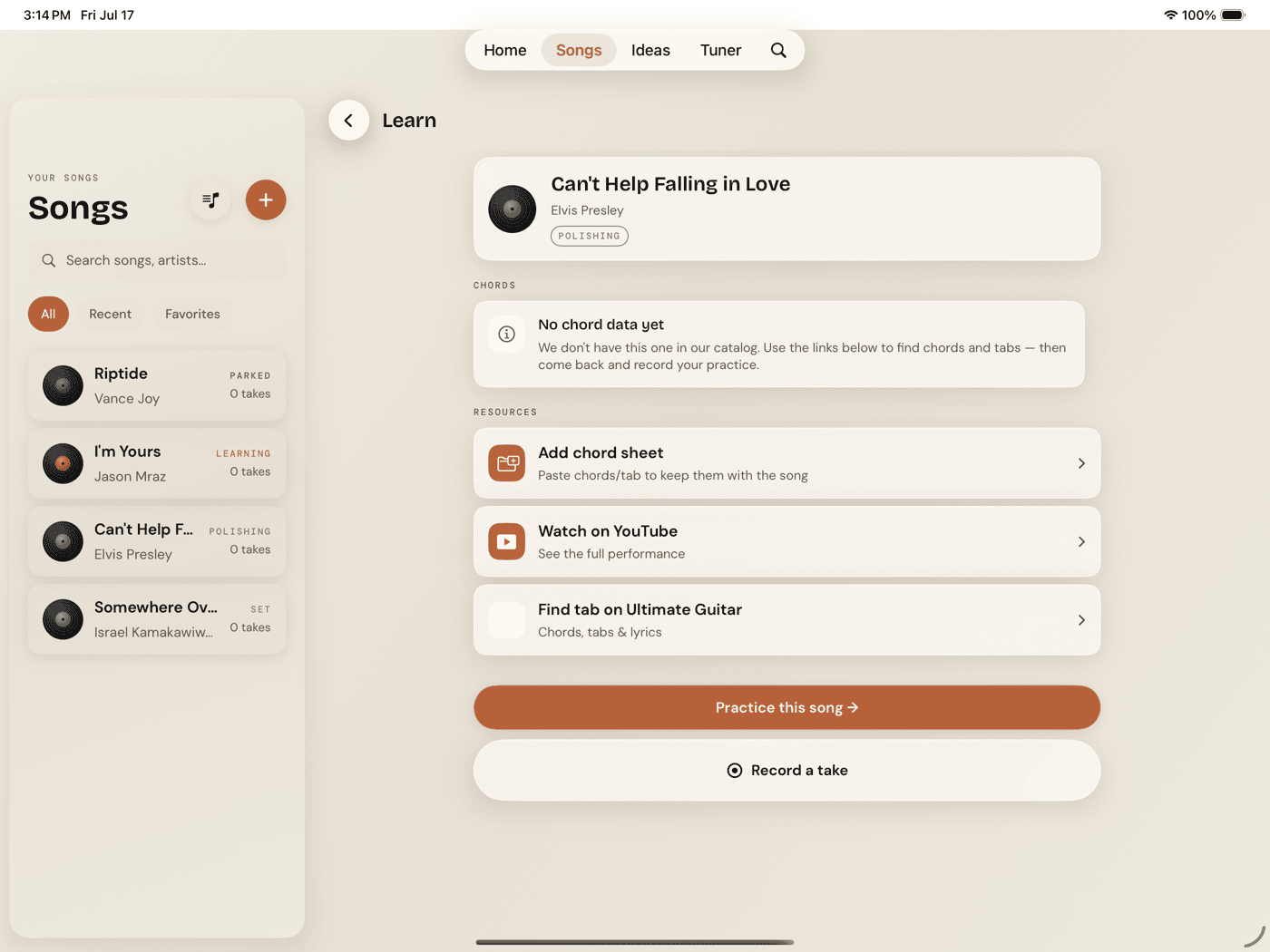
Songs and Ideas become a split view: the library list stays put as a permanent sidebar on the left, while whatever you've selected shows its full detail on the right. On iPhone, tapping an item pushes you forward and back brings you out. On iPad, both are just always there at once.
The grids widen too. Home's four action cards sit in a single row instead of stacking 2×2. Practice Hub's eight tool tiles, below the three featured cards, pick up extra columns instead of the tighter grid you scroll through on iPhone, and the Chord Library and Scale Library grids fit more columns automatically, however much width the screen gives them.
Jam's landscape Performance Mode works the same way it does on iPhone — rotate to landscape and the full-band view takes over the screen.
iPad adds one thing iPhone doesn't have here — an explicit back-chevron button to exit Performance Mode. On iPhone, rotating back to portrait exits it. iPad doesn't have a reliable version of that gesture, so there's a button instead.
Apple Watch
Ukulele Buddha's Apple Watch app is a separate, fully standalone watchOS app — it works without the iPhone app installed or nearby. Nothing to pair, nothing to sync.
Three pages, swiped through horizontally:
- Metronome — a big BPM readout, set with the Digital Crown or ±5 buttons, a four-beat dot pulse, and play/stop.
- Tuner — auto-detects which string you're playing. Standard gCEA tuning only; there's no alternate-tuning picker or manual string-lock on the Watch, so Low-G, Baritone, and D Tuning stay on the phone.
- Chords — one chord at a time: name, diagram, and a Strum button that plays it through the Watch speaker. Page through the same chord catalog as the phone with the Crown.
It's a deliberately stripped-down app — a glance-at-your-wrist subset, not a smaller copy of the phone app. No Scale Library, no Chord Coach or Scale Coach, no recording. Those all assume a screen bigger than your wrist and a free hand you don't have while you're playing.
Mac
Ukulele Buddha for Mac is a native app, not a stretched iPad build, and it's live on the Mac App Store today — the same universal purchase as the iPhone and iPad app, kept in step with them release for release. The progression builder, the genre and mood packs, and the groove picker are all in the Mac build too; it's the same code, given a desktop window to live in.
The tab bar is gone, replaced by a sidebar split into two groups: Library (Home, Songs, Ideas) and Play (Jam, Practice, Tuner, Search). The one real behavioral difference sits inside that Play group — on iPhone and iPad, Jam takes over the whole screen as a full-screen cover; on Mac it's a normal sidebar destination, and you click into and out of it exactly like you would Songs or Practice.
A real Mac menu bar comes with it. File ▸ Learn a Song… (⌘N) and File ▸ Capture Idea… (⇧⌘N) drop you straight into those flows without touching the sidebar. A View menu lists all six destinations with ⌘1 through ⌘6, plus ⌘F for Search from anywhere in the app. Settings behaves like a Mac app's, too — ⌘, opens it in its own window, the same panel Home's avatar circle opens, minus the Camera row, since there's no document scanner here.