Progressions
A library of common ukulele chord progressions — the Hawaiian vamp, 12-bar blues, jazzy turnarounds — each one playing against a full live band, so you're locking in chord changes against real drums, bass, and keys instead of counting through them in silence.
Knowing where your fingers go for a chord and knowing how to move them on the beat are two different skills, and most practice tools only train the first one. Progressions is built around the second. Every progression in the library — the Hawaiian vamp, 12-bar blues, a jazzy ii-V-I turnaround, the pop I-V-vi-IV, and more — plays with a full band behind it, so changing chords becomes something you do to a groove, not something you do into silence.
The progression library
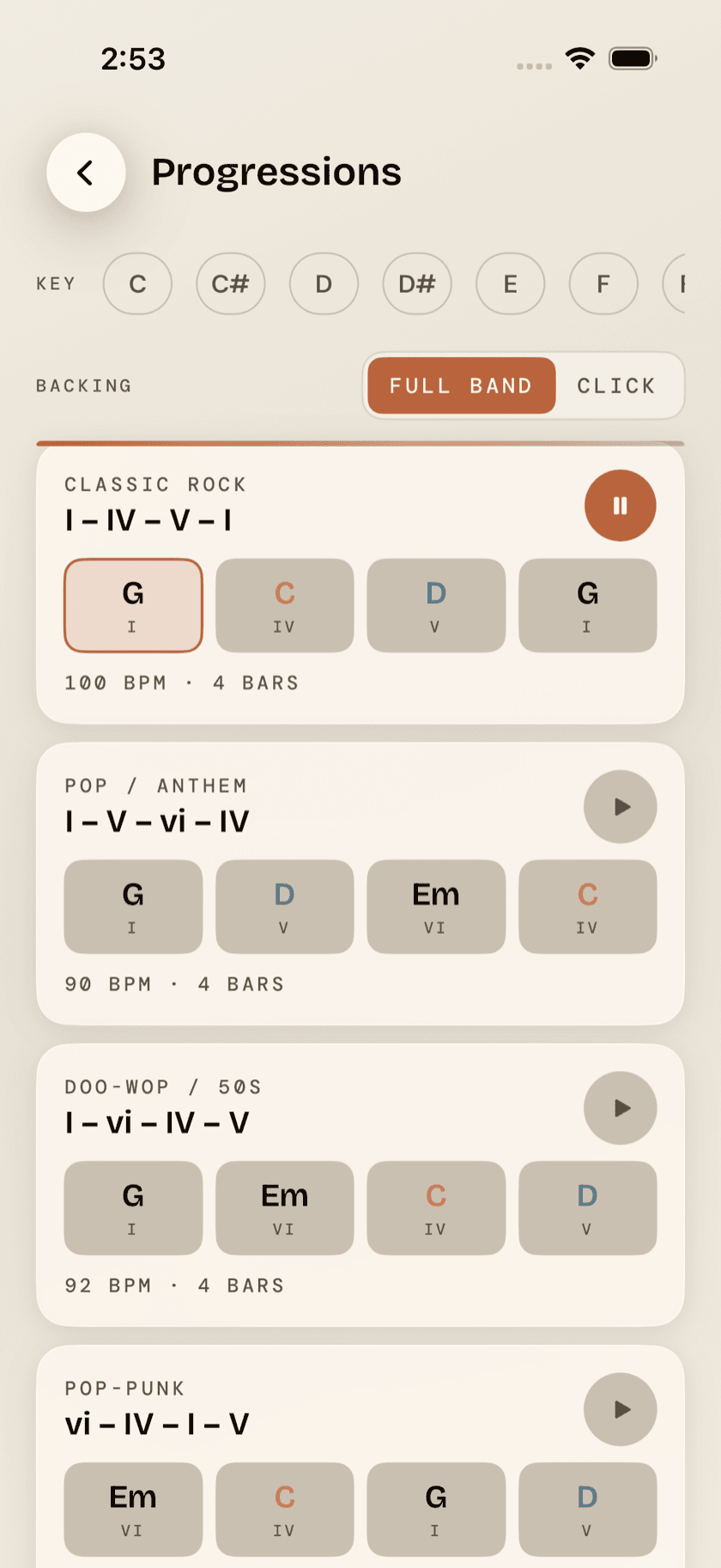
Progressions opens on a list of cards, one per progression. Each card lays out its chord blocks in order, its genre, and its tempo, and every block is colored by harmonic function — tonic, subdominant, or dominant — rather than just labeled with a chord name. Tap the inline play button on any card and a live band preview starts right there in the list, so you can hear what a progression sounds like before you commit to opening it.
There are forty-one progressions in the library, sorted into nine packs: Classics, Pop, Rock, Folk & Country, Blues & Jazz, Soul & R&B, Dreamy, Sad & Moody, and Reggae & Latin. A filter row above the list narrows it to one pack at a time. That's the quickest way in when you know the mood you're after but not the name of the progression that gets you there.
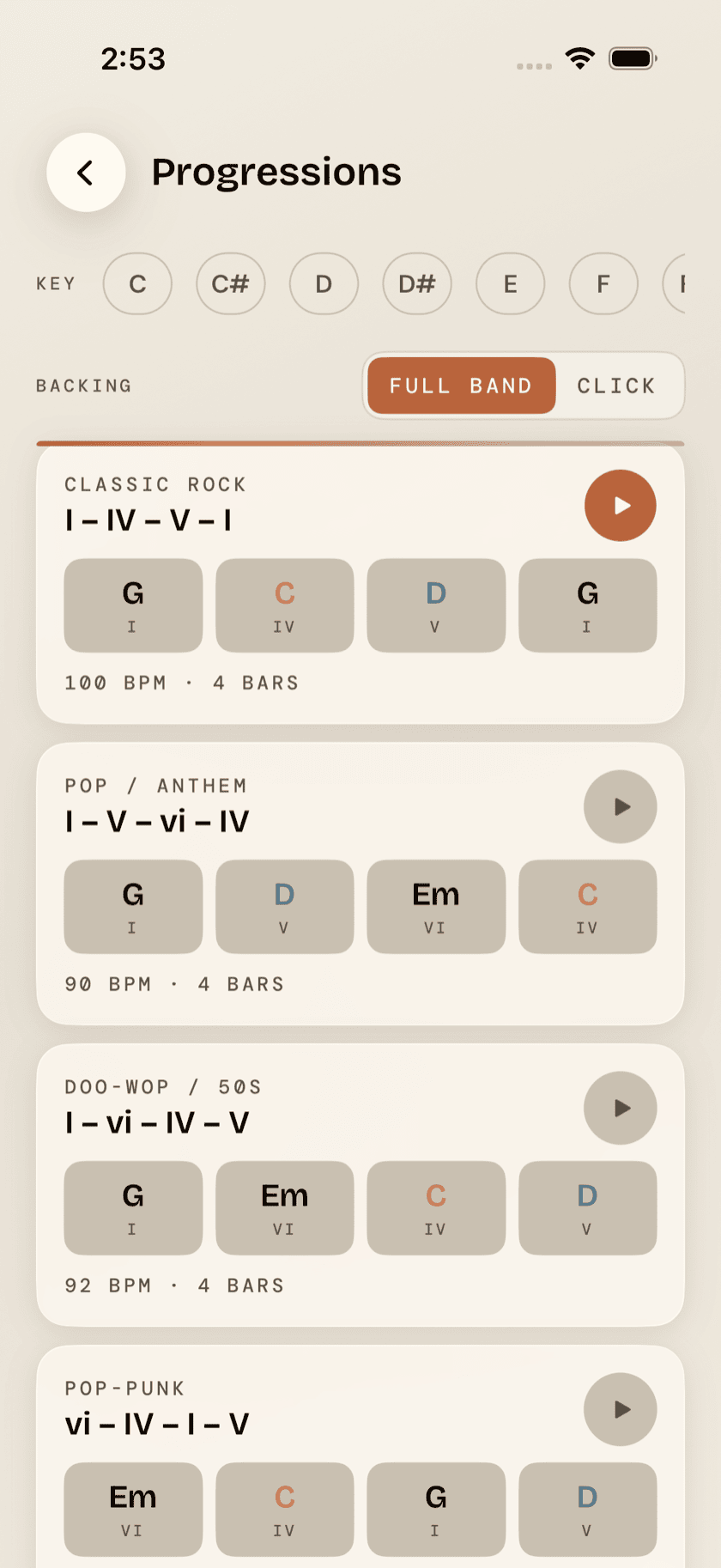
Function coloring earns its keep more on ukulele than the chord letters let on. The Hawaiian vamp is the same tonic-subdominant-tonic-dominant shape whether it's sitting in C or in G — the chord names change, the colors don't. Once you're reading color instead of letters, that shape jumps out everywhere it hides, which on ukulele is often.
Practicing a progression
Tap into a progression and it opens full-screen, focused on that one progression and nothing else. A NOW badge tracks the live chord as the band plays through it, next to a four-string fingering diagram for whatever chord is current. Underneath sits a strum strip — most of the library carries a named pattern picked to suit it, and the rest show a plain one in the right feel, so there's always something to play the changes with. A key picker sits within reach the whole time — change it and the chord blocks, the fingering diagram, and the band all transpose together, so you can work the same vamp in whichever key actually fits your voice. Tempo sits right there too, for slowing a fast turnaround down without leaving the screen — and on the swung ones, blues and jazz, a swing control turns up beside it.
Below the strum strip, a scale to practice card draws the scale that fits what's playing — the blues scale over a 12-bar, natural minor over a minor loop, the major scale over the rest — with a pentatonic option next to it if you'd rather keep it simple. It follows the key picker, so it's always the scale for the key you're actually in.
Same chords, a different groove
The groove behind a progression isn't fixed. A row of grooves sits on the practice screen — the same set Jam uses — and picking a different one re-feels the whole band without touching the chords. About half the library opens on Island — the uke's house lilt, a straight feel that suits the straight-feel progressions. The others start on a groove that fits them instead: the blues and jazz entries swung, the soul ones on Funk and Hip-Hop, the dreamy ones on Half-Time, the reggae ones on Reggae. Wherever a progression starts, moving it is the point — a vamp that lilts along on Island becomes a different song on Shuffle, on Half-Time, on Reggae. Rock, Blues, Funk, Jazz and Hip-Hop are in there too. The changes stay exactly where they were; everything underneath them moves. One thing to expect: move a progression off its own groove and the named strum steps back, leaving a plain pattern in the new feel. A shuffle strum over a straight backbeat would only fight you.
It's worth doing on purpose rather than idly. A progression you know cold on Island has a way of falling apart on Funk, and finding out which ones those are is most of the value. On progressions you've built yourself the choice sticks, so a custom one comes back the way you left it.
Build your own
If the library doesn't have the progression you're after, build it. Build a progression sits just above the bundled list; pick chords, put them in the order you want, set a tempo, and save it. What you save files under Your progressions at the top of the screen, with an edit and a delete behind the ••• on its card, so a loop that nearly works can be fixed rather than rebuilt. A custom progression isn't a lesser version of the bundled ones — it plays with the same full-band backing, and it transposes with the key picker exactly like anything already in the library.
The builder leads with the chords that actually live in your key, in labeled rows: the seven that belong there, then borrowed chords, then secondary dominants. A major/minor toggle sits over the palette — flip it and the rows redraw for a minor key: the seven that live there, then a short spice row of the chords a minor progression reaches for when it wants to go somewhere. Each chip carries its Roman numeral — uppercase for the major chords, lowercase for the minor — so the shape of the key stays visible while you work. The full root-and-quality picker is still underneath when you want something from outside it.
Chords don't have to take one bar each, either. Tap a chord you've added and you can set it to hang for one, two, or four bars, up to sixteen bars total. Plenty of ukulele songs move that way — sitting on the tonic for two bars before anything happens — and a loop built one-chord-per-bar rarely sounds like the song you had in mind.
Full band or just a click
Every progression, bundled or your own, can play two ways: the full drums/bass/keys arrangement, or a plain metronome click with the chords still advancing on schedule. The band is there to give you something to lock into while the changes are still new. The click strips that away and leaves just the timing — worth switching to once the band's help isn't what you need anymore.